Our organisations have transformed dramatically over the last decade. Has our approach to developing leaders kept pace?
During a recent conversation with a group of leaders, someone said something that stopped people in their tracks.
The comment landed.
Heads nodded.
This feeling didn't arise because they lacked capability. Quite the opposite.
These were talented, thoughtful leaders who had built successful careers through expertise, hard work and a willingness to step forward when challenges arose.
But many recognised the feeling of running and never quite arriving. The pace had increased. The volume had increased. The complexity had increased. And somewhere in the middle of all of it, there was less space to think, less space to connect and less space to make sense of what was actually happening and what to do in response.
Perhaps you've felt this too.
Most leaders don't need convincing that leadership has changed. They're living it every day.

The tricky part is, how do we address it?
At first glance, it's tempting to assume this is simply a capability problem. In fact, that's currently how many organisations are tackling this challenge – giving leaders more tools, more knowledge and more skills.
But I left the conversation thinking…
What if we've got it wrong?
Throwing more skills at a leader is unlikely to solve the challenges they are facing.
It may even add to the overwhelm.
Adding new skills is the equivalent to downloading new apps onto our phones. But to address a challenge of this magnitude, what we need is to upgrade our operating systems.
I'll explore how we can do this.
What is the world today asking of its leaders?
Our organisations have transformed beyond recognition. Technology has reshaped how work gets done. AI is rapidly changing what is possible. Hybrid working has redefined how teams connect. Data continues to grow exponentially whilst organisations navigate increasing complexity, uncertainty and interdependence.
Yet leadership development has evolved at a much slower pace.
We've added new tools, new content and new skills. These have brought value, to an extent. But they don't fully address the deeper shift taking place. Because in many ways, today's world is asking for something fundamentally different from its leaders:
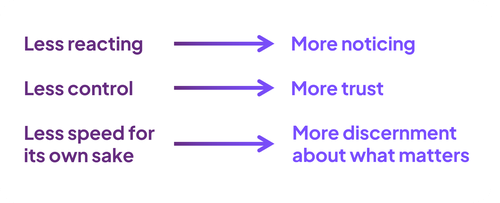
These shifts in ‘ways of being’ may feel daunting for the most seasoned of leaders, let alone new leaders. Which raise another important question:
Are we investing in people early enough?
Almost every organisation I work with wants to become:
More adaptive.
More innovative.
More resilient.
Better able to respond to uncertainty and complexity.
We often talk about adaptability as though it lives in strategy, culture or the executive team.
But organisations don't become adaptive because a handful of senior leaders are adaptive.
Organisations become adaptive when leadership capacity is distributed throughout the system.

Every day, thousands of conversations, priorities, decisions and relationships either improve or reduce an organisation's ability to respond to change.
If leadership capability sits mainly in the top third of an organisation, decision-making slows, dependency grows and adaptability becomes increasingly fragile.
In increasingly complex environments, organisations don't simply need exceptional leaders at the top.
They need leadership capacity woven throughout the organisation.
And that means one of the most strategically important transitions in any organisation may also be one of the most overlooked:
The moment someone steps into leadership for the first time.
Because the foundations we build during this transition shape every leadership role that follows.
The huge upside here is that if organisations focus on improving how and when they develop their leaders, they won't only solve their High Potential Talent pipeline challenges. They won't only equip their leaders to navigate the complex world they're now facing (which in itself is a huge win).
They will also address a potentially even bigger challenge – adaptivity.
For the whole organisation.
This becomes less of a reactive problem-solving exercise for leadership development, and more of an active investment into the adaptivity and resilience of the entire organisation.
First time leaders are a critical but underinvested in group
Having worked with leaders at every level, we've become increasingly convinced that one of the most underleveraged opportunities sits much earlier in the leadership journey. One piece of research from Zenger Folkman helped crystallise something I'd been noticing in conversations with clients for years.
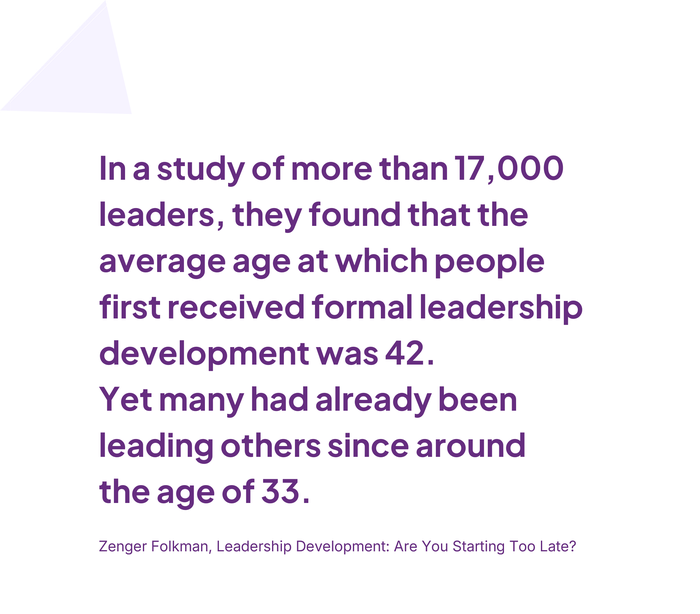
In other words, many leaders are navigating one of the most significant transitions in their career for up to a decade before receiving meaningful investment in their development.
Perhaps the question isn't whether organisations invest in leadership.
Many do.
Maybe the better question is whether we're investing in the right people, at the right time and in the right way for the world they now operate in?
Because if the foundations of leadership are built early, waiting almost a decade to make our biggest investment feels like a missed opportunity.
How we can build different foundations
At BRIDGE, we've spent more than 35 years working with leaders at every level of organisations.
That breadth of experience has led us to an increasingly simple observation:
Whilst leadership matters at every level, the foundations built during the first transition into leadership have a disproportionate impact on everything that follows.
That thinking sits behind EVOLVE, our intervention for new leaders that many of our clients over the years have expressed a need for.
It's built to help leaders make exactly the shifts we started with.
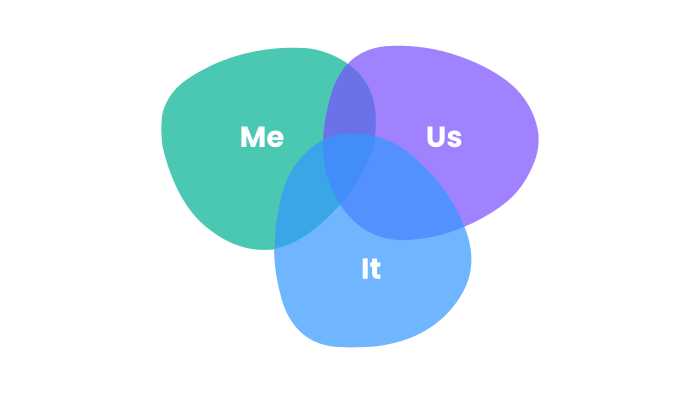
1) Less reacting, more noticing – beginning with ME, how I lead myself. Helping leaders develop the awareness, habits and resilience to be at their best more of the time.
2) Less control, more trust – expanding into US, how I lead others. Building safety and trust, strengthening relationships and having the conversations that create collective capacity.
3) Less speed for its own sake, more discernment about what matters – extending into IT, how we lead within the wider system. Creating enough meaning, clarity and momentum to lead with intention within increasingly complex organisational systems.
These aren't three separate capabilities. They build on one another.
Because leadership isn't simply about what we do. It is about who we become, the relationships we build and the conditions we create for others to do their best work.
So perhaps the question is no longer simply:
How do we develop better leaders?
Perhaps it is:
How do we build greater leadership capacity throughout our organisations?
Because if organisations are to become more adaptive in the face of increasing complexity, that adaptability cannot sit solely in the boardroom.
It must be built throughout the system. Beginning with the very first transition into leadership.
The organisations that thrive in the years ahead may not simply be those investing in better leadership programmes.
They may be those willing to rethink where, when and how leadership capability is built.
And it begins much earlier than we thought.